Watching rugby league from the touchline: a newcomer's guide
The first twenty minutes tell you most of what you need. Here is what to watch, what the terms mean, and what to write down before the picture gets complicated.
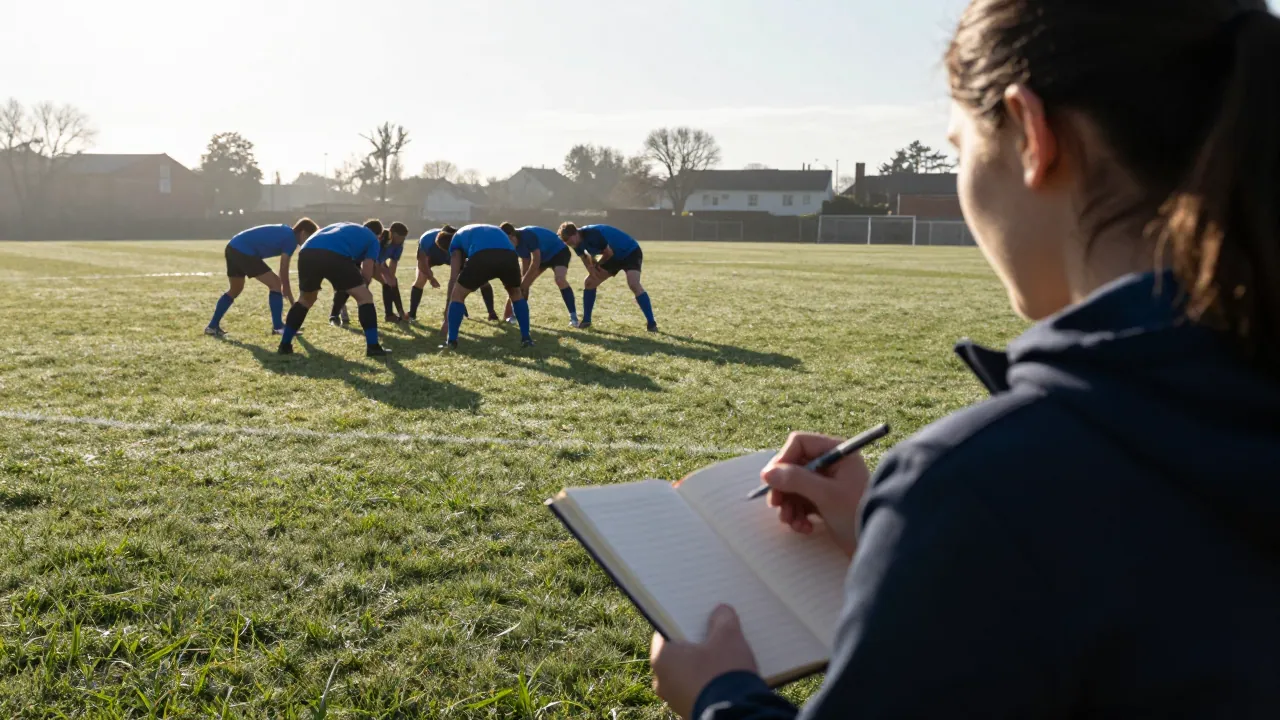
Rugby league looks chaotic from the touchline the first time you see it live. The ball moves, the whistle goes, a team restarts from the middle, and nobody around you seems confused. That gap between your notes and everyone else's is the problem we set out to fix in our spring workshop for journalists new to the code. We spent a morning at a volunteer-run tournament, notebooks open, watching the same twenty minutes again and again. This guide gathers what we learned about the rhythms of the game, the cues worth watching early, and the habits that make a first report accurate. If you usually cover soccer, start with how to read a match as a journalist and then come back.
What rugby league actually is, in plain words
Rugby league is a thirteen-a-side game played in two forty-minute halves. Teams try to carry an oval ball over the opponent's goal line to score a try, worth four points, and then convert it with a kick for two more. A penalty goal is worth two, and a drop goal one. That is the scoring. The rhythm is different from soccer: play stops and restarts constantly, and most of the tactical story lives in those restarts.
The central rule is the tackle count. A team gets six tackles to advance the ball. If they are tackled six times, possession passes to the other side. Most teams kick on the sixth tackle to move the ball downfield and make the opponent start from deep. That single rule explains more of what you see than anything else, including why a team sometimes seems to give the ball away on purpose.
The other terms you will hear: the ruck is the moment after a tackle when the ball is played back with the foot. A play-the-ball restarts play. A scrum is a contested restart used after certain errors, though it is rarely a genuine contest now. Ten metres is the distance defenders must retreat after a tackle, and the referee will call it loudly. Offside, forward pass and high tackle are the calls you will hear most.
The first twenty minutes: what to watch
At our workshop we asked everyone to ignore the ball for the first five minutes and watch the defensive line instead. The line tells you who is organized. A team that moves up together, in a straight line, and stops at the same moment is well coached. A team that drifts sideways or leaves gaps is about to be tested. Note which side of the field the line looks thinner on. That is where the first try usually comes from.
Next, watch the kickers. In the first twenty minutes you will usually see several kicks: restarts after tries, long kicks on the sixth tackle, and short kicks near the line. Note who kicks, from where, and how the receiving team responds. A fullback who catches the ball on the run and returns it twenty metres changes the momentum of a half. A team that cannot catch a high kick will lose field position all afternoon.
Then watch the ruck. The camera follows the ball carrier, but the game is decided by what happens in the two seconds after the tackle. Is the defending team slowing the play-the-ball down? Is the attacking team winning the ground quickly? A team that wins the ruck consistently will look tired in the second half only if they have been doing it badly. Write down two or three rucks where the defending team seemed to hold on too long. The referee's penalty count will usually match your notes.
Finally, note the referee's signals. Rugby league referees use clear hand signals for a penalty, a try, a scrum and a restart. In our workshop, the journalists who wrote down the signal and the reason for each stoppage in the first twenty minutes filed accurate reports. Those who waited until the end to reconstruct the sequence got details wrong. If you are covering a tournament with volunteer officials, as we often do, this habit matters even more; see our notes on running a press box for a volunteer-run rugby tournament.
| What you see | What it usually means | What to note |
|---|---|---|
| Team kicks on the sixth tackle | They are conceding field position to defend a set | Where the kick lands, who catches it |
| Referee calls ten metres | Defenders were slow to retreat | Which team, how often |
| Scrum in midfield | A handling error or forward pass | Which team put the ball in |
| Short kick near the line | A planned attacking play | Who chased it, who defused it |
| Penalty for holding down | The ruck was slowed illegally | The tackler, the count |
Common misconceptions we hear from new writers
The first is that rugby league and rugby union are the same game with different names. They are not. League has thirteen players, six tackles and no lineouts. Union has fifteen players, contested scrums and lineouts. The two codes have different rhythms and different vocabulary, and a report that mixes them will be noticed immediately by readers who follow either.
The second is that a team kicking the ball away is playing badly. In league, kicking on the sixth tackle is often the smartest option. It moves the game to the other end and forces the opponent to start from deep. A team that tries to run the ball on every sixth tackle will usually lose ground. Do not write that a team gave the ball away carelessly unless you saw them do it on an early tackle.
The third is that the game is only about big hits. Tackling matters, but the best teams win by controlling the speed of the ruck and the position of the ball. In our workshop, the writers who focused on collisions filed colourful reports that missed the tactical story. The writers who counted tackles and watched the line filed reports that coaches and players recognized.
What we changed after the workshop
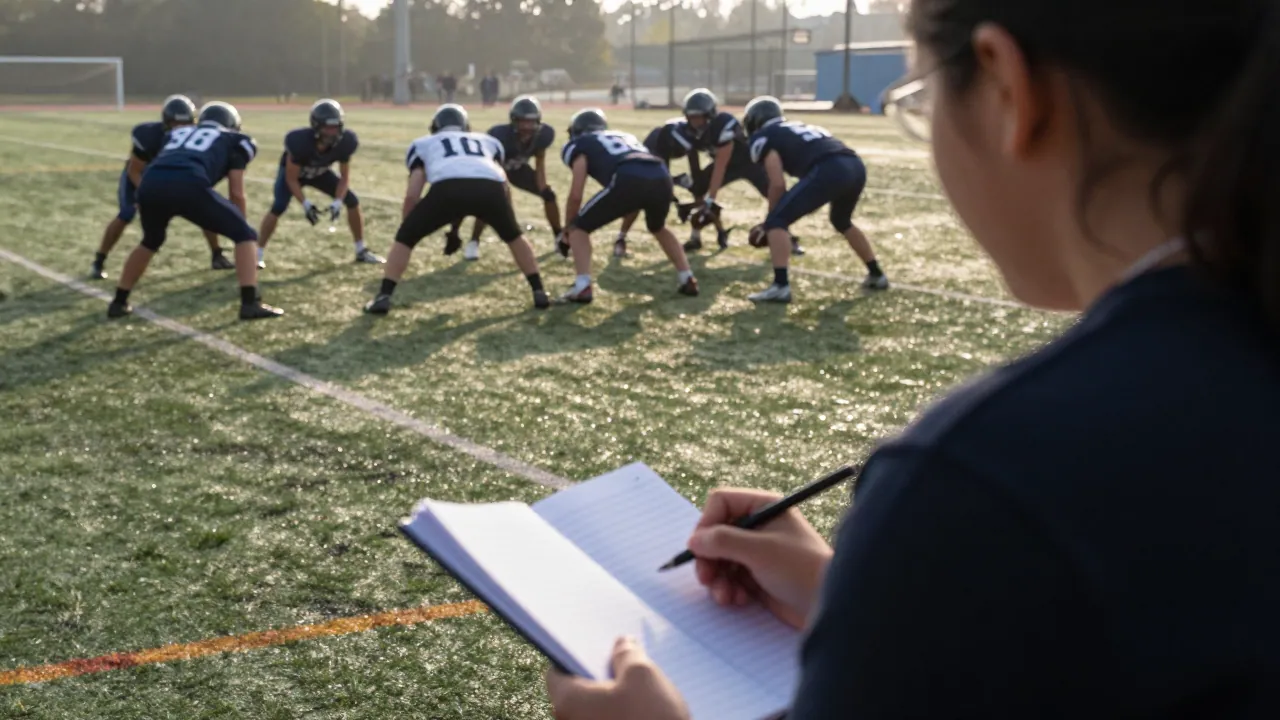
We ran the session twice last season, once in the spring and once in the autumn. In the spring, we gave everyone a full rulebook and a glossary. Most people read neither during the match. In the autumn, we handed out a single card with three things: the tackle count, the referee's signals, and a space for ruck notes. The notes came back far more useful. We now use the card in every session for journalists new to the code.
We also changed how we watch the first twenty minutes. Instead of asking people to follow the ball, we asked them to watch one team without the ball for the first ten minutes, then the other. That is harder than it sounds, but it produced better questions. One writer noticed a defensive line that stopped moving after the third tackle; that observation became the opening paragraph of their report.
The last change was smaller. We started writing the score and the tackle count at the top of every page of notes. At the end of a half, those numbers are the spine of the report. Without them, you rely on memory, and memory is generous with details. If you are building a data habit alongside your notes, our piece on tracking player movement data without a budget has practical options for volunteer setups.
The habits that carry over to any code
The touchline habits we teach are not specific to rugby league. Watch the structure before the ball. Write down the time and the reason for every stoppage. Ask one question at half-time rather than five. And keep your notes in a form someone else could read, because at a volunteer tournament the person beside you may be filing the only report anyone sees. That is why we keep our workshop notes in order and share them with every new writer.
If you are covering your first rugby league match this season, give yourself the first twenty minutes to count tackles and watch the line. The rest of the game will explain itself. If you are coming from soccer, the transition is easier than you think, and our guide to reading a match as a journalist covers the habits that travel between codes. Bring a notebook, a pencil and a card with three columns. That is enough to start.
Questions people ask
How many tackles does a team get in rugby league?
Six. After the sixth tackle, possession passes to the other team unless the ball has been kicked or a penalty has been awarded. Most teams kick on the sixth tackle to move the ball downfield, so the count is the key to understanding the game's rhythm.
What is the difference between rugby league and rugby union?
League has thirteen players and six tackles; union has fifteen players, contested scrums and lineouts. The scoring and the stoppages differ too. A report that mixes the two codes will be spotted quickly by readers who follow either game.
What should I write down in the first twenty minutes?
The tackle count, the referee's signals and the reason for each stoppage. Note which team is winning the ruck and where the defensive line looks thin. Those notes will carry you through the rest of the match and give your report a spine.