How to read a soccer match as a journalist, not a fan
A practical guide to taking notes on shape, pressing triggers, and substitutions so your first match report reads like analysis, not a diary of feelings.
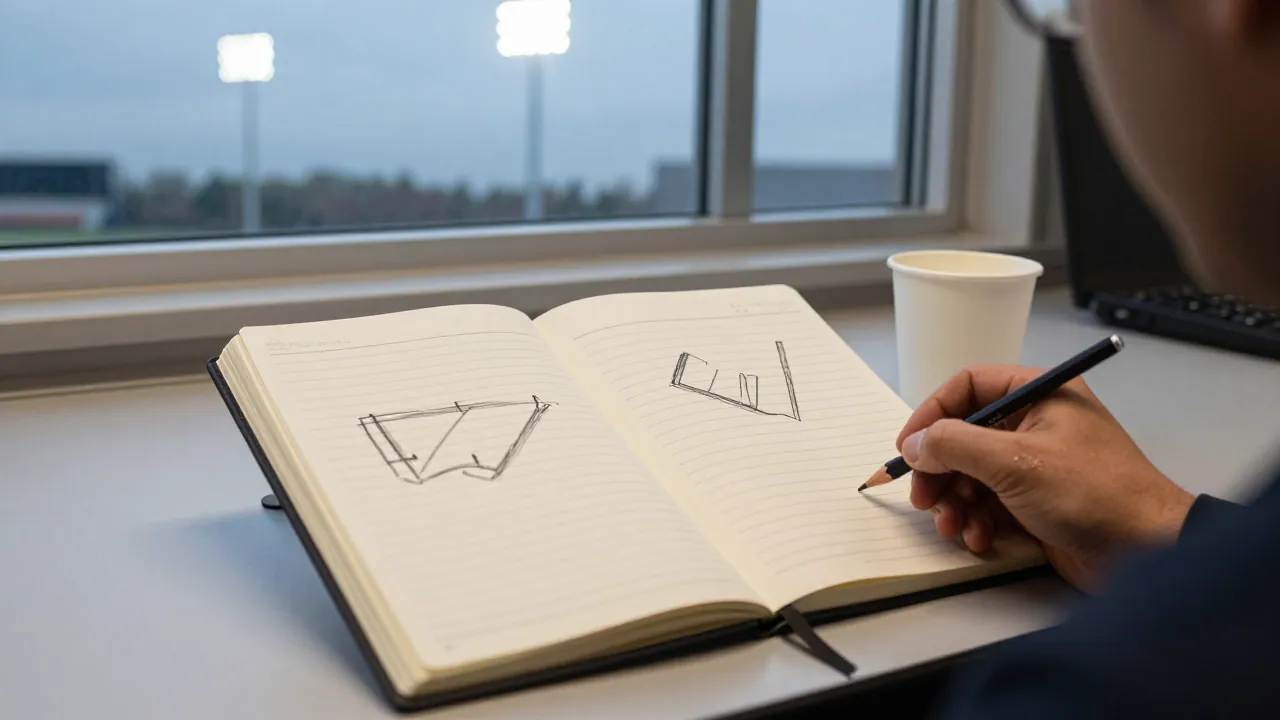
You are in the press box for the first time. The teams walk out, the crowd noise rises, and your notebook is open. Then the whistle goes and everything happens at once. This guide is for volunteer reporters and bloggers who have watched plenty of soccer but never had to write about it under deadline. By the end, you will know what to watch before the ball is in play, which notes to take during each phase, and how to turn those notes into a file that sounds like analysis rather than a fan's diary. The habits are simple, but they need practice, which is why we run them in our training workshops.
Before kickoff: build the frame you will write inside
Most first-time reporters start writing when the ball moves. By then they are already behind. The useful work happens in the ten minutes before kickoff, when you can still see both teams set up. Start with the team sheet: write out both lineups in the order they will stand, not the order they appear on the sheet. A 4-3-3 and a 4-2-3-1 can look identical on paper, so draw the shape you actually see.
Next, note the match context that will matter later: competition, round, weather, pitch condition, and whether either side is missing a regular starter. This is also the moment to check your press pass and seating, which we cover in detail in what our accreditation clinic taught us about press passes. If you cannot see the far side of the pitch clearly, write that down too. It will explain any gaps in your notes.
- Both starting lineups, drawn as shapes rather than lists.
- Bench players and their usual positions, so substitutions make sense later.
- Weather, pitch, and any visible damage or markings that could affect play.
- The time you started and the seat or position you are watching from.
During the match: three columns, not one
The single biggest change a first-time reporter can make is to split the notebook page into three columns: time, observation, and interpretation. In the observation column, write only what you could show someone on video. In the interpretation column, write what you think it means. Keeping them apart stops you from filing a guess as a fact, and it makes the post-match quotes easier to place.
For shape, watch the back line, not the ball. Note how high the defensive line sits when the team has possession, and how quickly it drops when they lose it. For pressing, note the trigger rather than the tackle: a backwards pass, a heavy touch, a player receiving with their back to goal. Write the minute and the player who started the press. Over 90 minutes you will see a pattern, and the pattern is the story.
| What you see | What to write | Why it matters |
|---|---|---|
| Fullback pushes high on the left | Minute, player, space left behind | Explains counterattacks and wingers' starting positions |
| Midfield drops into a back three | Minute, who dropped, who stayed | Shows a deliberate in-possession shape, not panic |
| Striker presses alone | Minute, nearest teammate's distance | Reveals whether pressing is coordinated or individual |
| Keeper plays short to a centre-back | Minute, pressure faced | Sets up the next paragraph on build-up risk |
You will also need to note rest defence: where the team stands when it attacks. Count how many players stay behind the ball. If a team attacks with seven and defends with three, that is a choice, and it explains why a fast winger causes so much trouble. Our guide to tracking player movement without a budget has simple methods for recording this without special software.
Substitutions: the part most new reporters miss
Substitutions are where a match report earns its keep. Note the minute, the player coming off, the player coming on, and the score at that moment. Then watch the next five minutes and write down what changed: did the team switch to a back three, push a winger inside, or drop deeper to protect a lead? If nothing changed, write that too. A substitution that changes nothing is still information.
Be careful with cause and effect. A goal after a substitution does not prove the substitution worked. Note the sequence separately: substitution at 64, goal at 71, and what happened in between. If you are covering a tournament with volunteer staff, the same discipline applies to the press box itself, which we describe in running a press box for a volunteer-run rugby tournament. The principle carries across sports: record the action first, explain it second.
What to write when the game turns
When a team scores or concedes, resist writing a paragraph of emotion. Write the build-up: who won the ball, where, and how many passes before the shot. Then write the reaction: did the conceding team change shape immediately, or wait for the next stoppage? That detail separates a report from a match diary.
Common mistakes and how to fix them
New reporters tend to make the same handful of errors. None of them are fatal, but each one weakens the file. The fixes are small habits, not new skills.
- Writing commentary instead of analysis. Fix: after each note, ask what it explains about the team's plan.
- Only watching the ball. Fix: spend five minutes each half watching one player away from the ball.
- Recording opinions as facts. Fix: keep the interpretation column separate and label it clearly.
- Forgetting the clock. Fix: write the minute before every note, even if it is approximate.
- Missing the substitution context. Fix: note the score at every change, not just the player's name.
Turning notes into a file that holds up
After the final whistle, give yourself fifteen minutes before writing. Read your three columns and mark the three or four observations that explain the result. Build the report around those, using the timeline as your spine. Add quotes only where they confirm or challenge what you saw. Then check every number against your tally, and check every name against the team sheet.
A match file that holds up is one a reader could use to understand what happened without having watched. That is the standard we set in our workshops, and it is reachable on your first attempt if you prepare before kickoff and keep observation and interpretation apart. The next step is to take the same habits to a different sport, as we suggest in watching rugby league from the touchline.
Questions people ask
Do I need a laptop in the press box?
No. A paper notebook with three ruled columns is faster to set up and does not run out of battery. Many volunteers take brief typed notes at half-time and keep the main record by hand.
How many notes should I take in a match?
Enough to explain the result, not every pass. Aim for 25 to 40 timed observations across the 90 minutes, plus a separate tally of shots, corners, and substitutions.
What if I cannot see the far side of the pitch?
Write it down at kickoff and rely on the near-side shape and the substitutions you can see clearly. Say in the report which parts of the pitch you could not observe.